
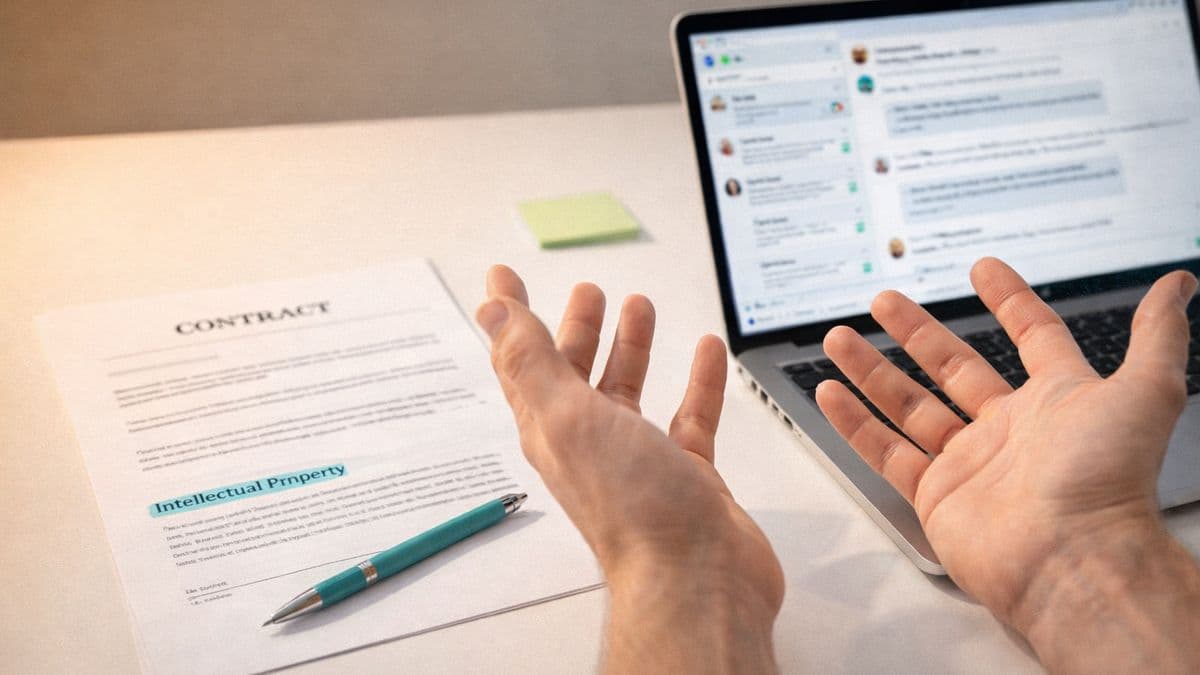
What to Do When a Client Will Not Sign Your Freelance Contract
You send over a contract and the client responds with something like "we do not usually do contracts" or "let us just get started and figure out the paperwork later." It happens constantly, especially with smaller clients, startups, and people who have never hired a freelancer before. The project sounds exciting, the money is good, and you do not want to seem difficult. So you consider just starting the work without a signed agreement.
That is one of the most expensive decisions a freelancer can make. Without a signed contract, you have no enforceable payment terms, no defined scope, no IP protection, and no legal recourse if things go wrong. Every hour you work without a contract is an hour of unpaid risk.
Why clients push back on contracts
Understanding the reason behind the resistance helps you respond to it. Most clients who refuse to sign are not trying to exploit you. They fall into one of a few categories:
- They think contracts are overkill for small projects. A client paying $500 for a logo may feel that a multi-page contract is disproportionate. They see it as unnecessary friction.
- They have never used one before. Some clients, particularly solo founders and small business owners, have never worked with a formal agreement. The process feels unfamiliar and intimidating.
- They do not want to involve a lawyer. Reading legal language makes people uncomfortable. If they do not understand the contract, they may avoid it rather than admit that.
- They want flexibility to change scope later. A contract pins down deliverables. Some clients prefer to keep things open-ended so they can add requests as the project evolves.
Only that last reason should concern you. The first three are solvable with the right framing and a simpler document. The last one is a red flag. A client who wants to avoid defining scope upfront is a client who will expect unlimited work for a fixed price.
Frame the contract as protection for both sides
The biggest mistake freelancers make is positioning the contract as something they need. That makes it feel one-sided. Instead, frame it as a shared safety net. The contract protects the client just as much as it protects you. It guarantees them specific deliverables by a specific date. It defines what happens if you disappear or deliver subpar work. It gives them recourse too.
Try something like: "I always use a short agreement before kicking off a project. It is mostly to make sure we are aligned on scope and timeline so there are no surprises on either side. It protects both of us." This takes the adversarial edge off entirely. You are not lawyering up. You are being professional.
Offer a lighter agreement
If the client is intimidated by a 10-page contract, meet them halfway. A one-page agreement that covers the essentials is vastly better than no agreement at all. At minimum, it should include:
- Scope of work. What you will deliver, in what format, and by when.
- Payment terms. How much, when it is due, and what happens if payment is late.
- Intellectual property. Who owns the work, and when ownership transfers.
- Termination. How either party can end the engagement and what is owed at that point.
Four clauses. One page. That is enough to protect you from the most common freelance disasters: unpaid work, scope creep, IP disputes, and sudden cancellations. You can even format it as a simple email with bullet points and ask the client to reply "agreed" to create a written record.
What if they still refuse?
If a client will not agree to even a one-page document, you need to decide whether to proceed. There are two paths from here, and only one of them is safe.
The paper trail approach
If you decide to move forward, create a written record through email. Send a message summarizing the agreed scope, deliverables, payment amount, timeline, and ownership terms. Ask the client to confirm by reply. This is not as strong as a signed contract, but an email chain where both parties acknowledge the terms can serve as evidence if a dispute arises later.
Be specific. Do not write "as discussed." Write out every detail: "I will deliver a 5-page website design in Figma by March 15. The total fee is $3,000, with $1,500 due before I begin and $1,500 due on delivery. Final files transfer to you after full payment." The more explicit the email, the more useful it is as a record.
The walk-away signal
Sometimes the refusal to sign is telling you something important about the client. If they will not commit to basic terms in writing, they are unlikely to honor those terms in practice either. A client who refuses a one-page agreement covering scope and payment is a client who wants the freedom to change both after you have started working. That is not flexibility. That is a setup for unpaid revisions, moving goalposts, and late payments.
Walking away from a paying client feels wrong, especially when you need the work. But the cost of a project gone bad (weeks of unpaid labor, legal fees, lost portfolio pieces) almost always exceeds the income you would have earned. Trust the signal.
Phrases that help move the conversation forward
- "This is a standard part of my process for every project, regardless of size." (normalizes the request)
- "I have a simple one-page version that just covers the basics. Let me send that instead." (reduces friction)
- "It protects you too. If I do not deliver on time, you have recourse." (shifts the framing)
- "I can not start work without a written agreement in place. Happy to keep it simple." (firm but flexible)
- "Would it help if I walked you through it? It is pretty straightforward." (removes intimidation)
Even a short contract needs a second look
Whether you use a full agreement or a simplified one-pager, the clauses still need to protect you. A short contract with a bad IP clause or a missing kill fee is not much better than no contract at all. The advantage of a shorter document is that it is faster to review, but you should still check that the payment, scope, IP, and termination language actually works in your favor.
Try ClauseGuard free to run a quick risk check on any freelance agreement, whether it is a full contract or a one-page deal memo. Upload the document and see which clauses protect you and which ones need work, in under 30 seconds.